
What is Scrum?
Scrum is an Agile Software Development methodology, used since the early 1990s.
With a focus on communication, Scrum is utilized to achieve efficient delivery of
complex software products.
Scrum enables high quality software by scheduling regular incremental releases (typically
every 2-4 weeks). Customers are closely involved in the process and are encouraged
to review (and change) priorities for the development based on their changing business
needs and user feedback.
"A key principle of Scrum is its recognition that during a project the customers
can change their minds about what they want and need (often called requirements
churn)" (Source:
Wikipedia)
Scrum is used the world over by companies including Microsoft, IBM, Sun, Intel,
Google, Yahoo, Oracle, Hewlett Packard, Sony Ericsson, Cisco, Philips, BBC, Motorola,
JPMorgan, CapitalOne, Alliance, Electronic Arts, DoubleClick, SalesForce.com, Nokia,
Siemens, Xerox, SSW and many more.
Why we're Awesome at Scrum
- We train people in Scrum all over the world
- We helped write the official TFS Scrum course
- Our developers are Scrum Masters for other companies' teams
- We use Scrum on all our internal and client projects
Check out this SSW TV video on a Microsoft Scrum Stand-up meeting.
Meet our Scrum Trainers
Scrum Services
Scrum Consulting
We provide experienced scrum consultants to mentor your team and transition to a scrum based methodology.
Book a Scrum Consultant
Scrum Development
We utilize scrum internally on all SSW projects, as well as customer projects. We provide certified scrum masters and dedicated scrum teams to customers.
Book a Scrum Developer
Scrum Training
We provide comprehensive scrum developer training. If you have an existing development
team and want to upgrade their skills, consider our Professional Scrum Developer training with TFS courses.
Book a 3-Day Training Course
Why choose Scrum?
Have you ever wondered...
- Why am I being told at the last minute by the developers that some features will not be included in the release?
- Why is my project delayed again?
- Why are there so many bugs when the whole system was fully designed in advance?
You may think it's just the developers that need to work better, but actually miscommunication and such problems can be eliminated if both client and developers adopt the working methodology Scrum.
Benefits of Scrum
- Transparency of development progress and processes
- Regular inspection of the process to limit variances
- Adaptation to changing circumstances or requirements
- Overall greater client satisfaction!
How does Scrum work?
The 3 key points in Scrum are:
- Time-boxed meetings with the client at the start and finish of a sprint to increase
the communication and efficiency between the client and the development team. This
is the Review and Retrospective.
- A daily 15 minute Scrum meeting where each team member presents a short summary
of yesterday's tasks, today's actions and impediments. In all cases, this is a good
opportunity to identify problems early. This meeting is led by the ScrumMaster (Project
Manager).
- Done criteria must be met before developers can affirm that a feature is complete.
Done criteria can include adding unit tests, having peer reviews and other good
engineering practices. By ensuring developers perform tests for each feature, quality
assurance is maintained and bugs are eliminated before they escalate.
In Scrum the client (called as Product Owner) re-prioritizes tasks at the beginning
of each sprint so the scrum team is always working on the most important features
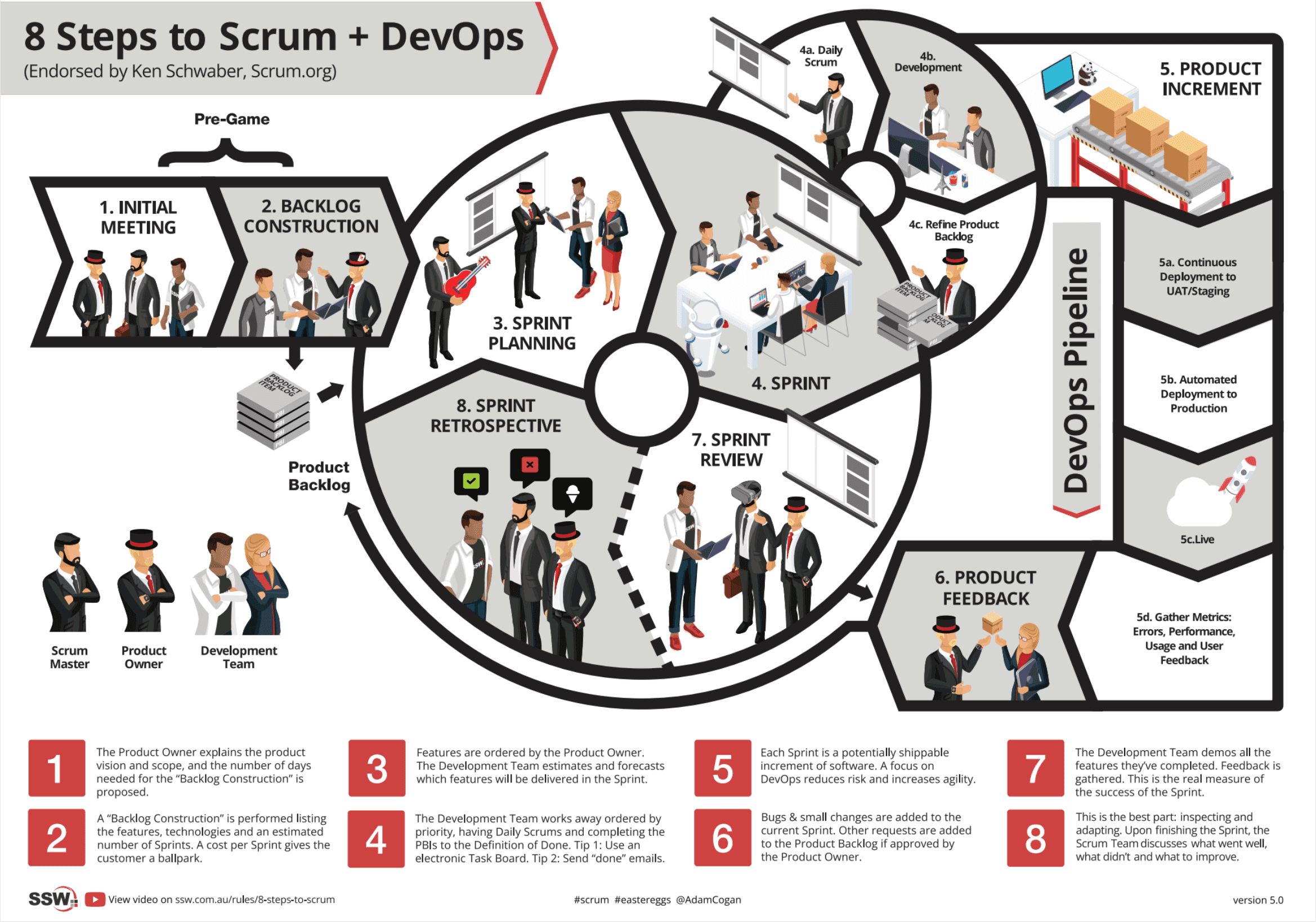
for the product. Check out our 8 Steps to Scrum diagram to easily vizualize how it works.
What are the Scrum Roles?
There are multiple roles in every Scrum team. These include the:
- Scrum Master
- Product Owner
- Team
Scrum Master
Responsible for ensuring the process is understood and followed. This is also who will attempt to remove any roadblocks the team faces.
Product Owner
Responsible for maximizing the value of the work that the Scrum Team does. This is often provided by the client so as to ensure they are getting what they expect.
The Team
Responsible for doing the actual work.
Key Technologies
Microsoft Team Foundation Server (TFS)
Microsoft Visual Studio + Team Foundation Server (TFS 2010, 2012 or TFSPreview) is a team collaboration platform that combines team portal, version control, work-item tracking, build management, process guidance, and business intelligence into an unified server.
JIRA and GIT
Not after a Microsoft solution? Atlassian's Jira and GIT (or other combinations like Mercurial and Axosoft's OnTime) can be combined to form a powerful platform for your portal, source control and requirements and bug tracking.
Related Links