
Appointments - Do you use the correct time and date format?
Last updated by Chloe Lin [SSW] about 1 month ago.See historyClear, unambiguous dates and times prevent missed meetings, costly travel mistakes, and confusion across countries and time zones.
“Catch up moved to 10/05 at 6. See you then”
Think about this, is that 10th of May or 5th of October? Is it 6 am or 6 pm?
Dates - kill the ambiguity
People in different regions format the date in different ways:
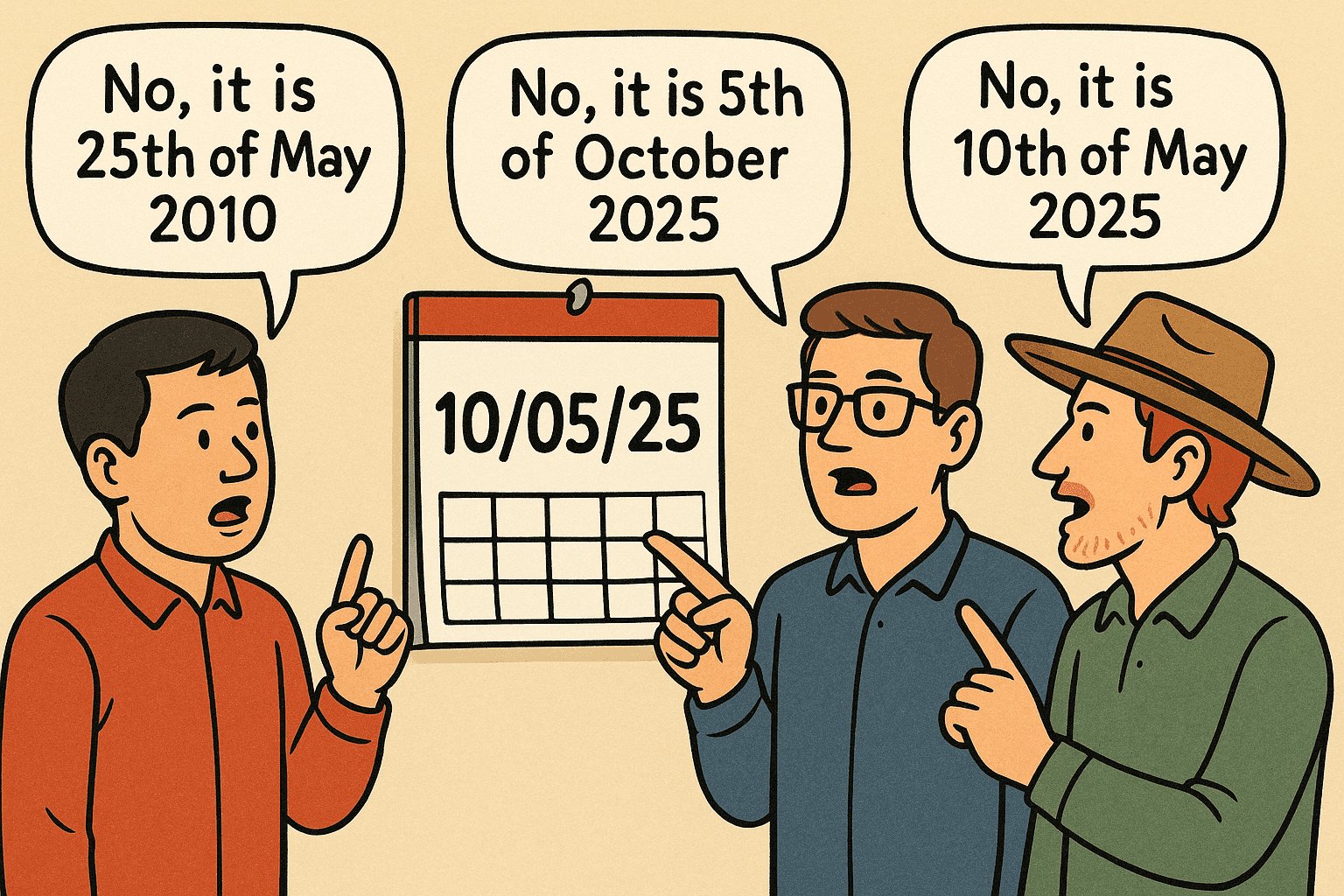
Software can also misinterpret it. For example, entering 10/05/2025 on an Aussie laptop could be read as October 5th, 2025, if opened on an American system.
This is why you should avoid numeric-only formats... they can cause major confusion. To make it even clearer, include abbreviated weekdays with dates.
"This email was sent on 10/05/25."
Bad example - Use slashes on their own, it’s ambiguous
"The email was sent on Sat 10 May 2025."
Good example - Use "DD MMM YYYY" and include the abbreviated day of the week
Times - 24-hour or am/pm - both are fine (when used correctly!)
Use valid formats to avoid confusion - both 24-hour and 12-hour formats are universal when used correctly:
- The user group will start at 6 (is this am or pm?)
- The user group will start at 18 pm (invalid format)
- The user group will start at 6.00 pm (use of dot)
Bad example - Incorrect or ambiguous times
- The user group will start at 18:00 tomorrow (24-hour format)
- The user group will start at 6 pm tomorrow (12-hour format)
Good example - Correct formatting for time
Avoid the 12 am / 12 pm trap.
- Use "noon" or "midnight" to the end of the time instead of just 12:00. E.g., 12:00 noon.
- For boundaries (e.g., validity periods), avoid 00:00; use 00:01 for start and 23:59 for end (common airline practice) to remove doubt.
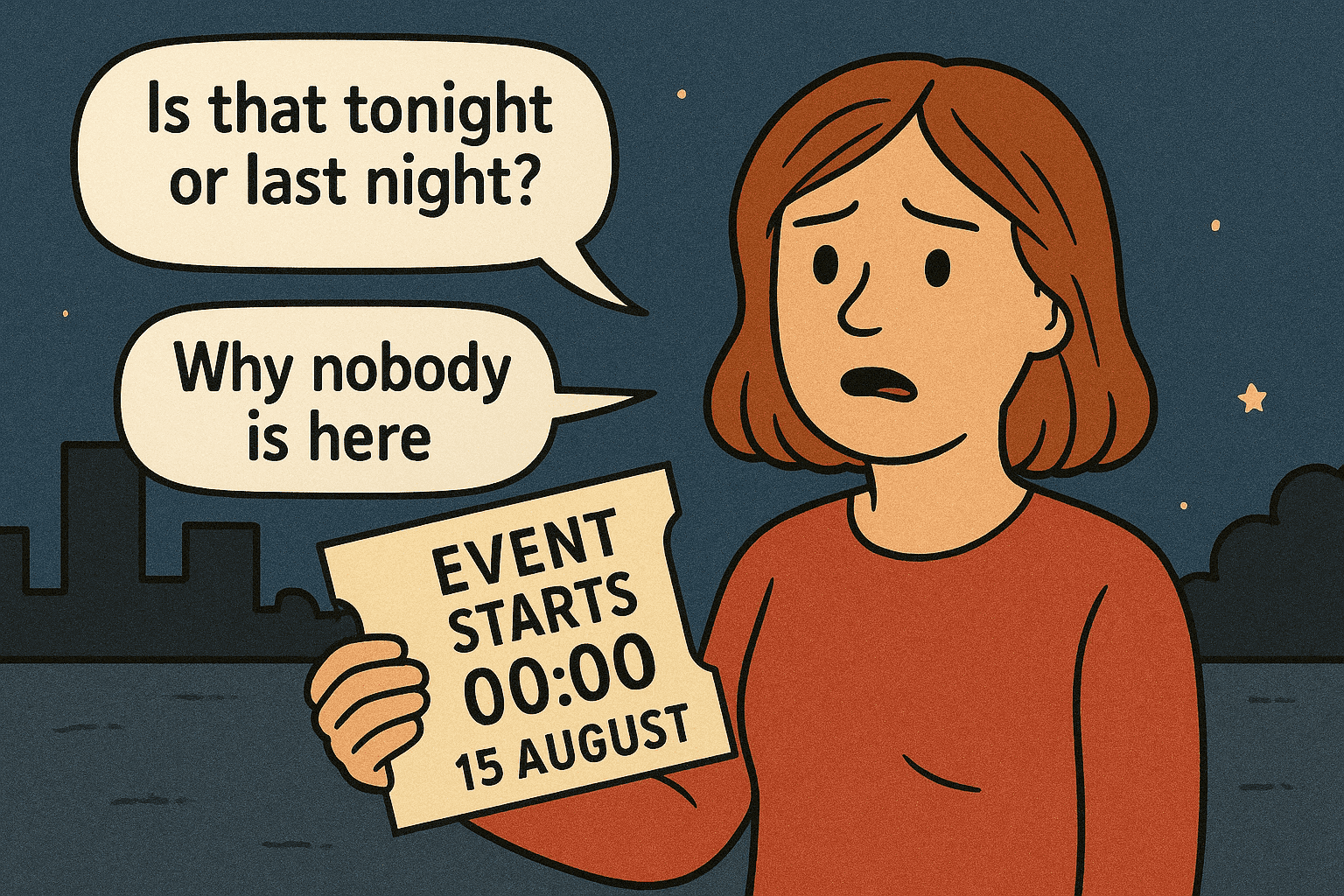
Always include a time zone for cross-location events: AEST (UTC+10), AEDT (UTC+11), PT (UTC–8), etc.
Extra tips
- Use leading zeros in 24-hour times: 09:05, not 9:5
- Don’t mix separators: use “:” for time, not “. “or “h.”
- Use “6 pm” with lowercase letters and a space for clear, modern, and style-guide-friendly time formatting
-
It is recommended to use the ISO standard (YYYY-MM-DD) for your filenames, so they can be sorted in descending or ascending order by time
- e.g., 2025-08-15-sprint-review-notes.md
