Prerequisites
Introduction
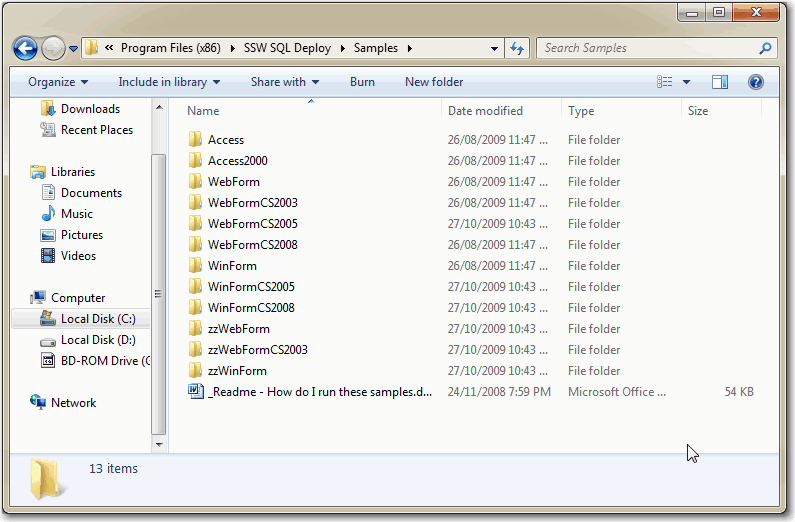
First install SQL Deploy by downloading and running the setup package. When the installation is complete, view the Samples
folder that the setup package has opened.

Figure: The first thing you should do is view the sample and look at the
sample code
Please take the time to look at the samples that are installed with the application.
There are samples for:
- Microsoft Access
- .NET Windows Forms
- ASP.NET Web Forms
The DatabaseSQLScript folder contains sample SQL scripts that
work with the supplied sample applications.
Using SQL Deploy in Directory Mode
What problem does SQL Deploy Directory Mode solve?
Directory mode helps to solve the problem of managing and applying updates to the Database. It uses a history table to keep track of the
updates that have been applied. This allows the DBAs and Developers to put their updates into a single folder and let SQL Deploy worry
about versioning the changes.
There is also a dll that is provided that allows you to integrate with
SQL Deploy and check if there is a new version.
Directory mode is designed to allow Developers to incorporate SQL Deploy into their applications to deliver Database updates quickly and
easily at the clients site.
The SQL DBA or Developer saves all of the database updates to a single folder. SQL Deploy monitors this folder and checks for SQL
scripts that have not been applied to the Database. It keeps track of the changes it has applied to the Database by updating a history
table.
For SQL Developers
When a new version of the Database is required, simply
- email the SQL scripts and the SQL Deploy Project (sdproj) file to the client.
- Instruct them to place these files into the directory that SQL Deploy is monitoring. When the application detects the new SQL scripts
the user will be notified that changes need to be made to the Database and a dialog similar to the following will be displayed.
The SQL Deploy DLL will display this dialog when it detects a SQL script that has not been applied to the database. The checking process is normally run when the application that is
using SQL Deploy is started.
When the user clicks on the Yes button, SQL Deploy will be launched with the SQL Deploy Project (sdproj) file as a parameter. The user has
only to click the Next button for each screen in the SQL Deploy wizard to apply the database updates.
You could also start the console version of SQL Deploy with will upgrade the
database with no user intervention.
You can start SQL Deploy with command line arguments to specify the initial values displayed in the wizard screens.
SSWSQLDeploy.exe [/XMLFile:settings.sdproj] [/TimeOut:value] [/UserMode:true|false] [/ReconcileScriptsMode:true|false]
[/FolderPath:folderpath] [/ConnectionString:connectionstring] [/SelectedFile:filepath] [/UseTransactions:true|false]
[/UpdateVersionTable:true|false]
OR
SSWSQLDeployConsoleUI.exe /XMLFile:settings.sdproj
| Parameter |
Description |
/XMLFile:sqldeployproject.sdproj | The Full path and filename of the SQL Deploy Project (sdproj)
file that contains the settings to use. |
/TimeOut:value | The connection Time out value to use when connecting to the SQL
Server. |
/UserMode:true|false | true to run in Directory mode. false to
run Single File mode. |
/ReconcileScriptsMode:true|false | true to run in Reconcile Scripts mode. |
/FolderPath:folderpath | The path to the folder that contains the SQL script files.
(not for Single File mode)
|
/ConnectionString:connectionstring | The connection string that specifies the Database
to make the updates to. |
/SelectedFile:filepath | The full path and filename of the SQL script file that SQL
Deploy should run. This option is only used with Single File mode. |
/UpdateVersionTable:true|false | If true entry will be added to the _zsDataVersion
table with the SQL script name and the date and time the script was run. Using this option is recommended.
|
Command line usage examples
Specifying the Connection string
SSWSQLDeploy.exe /ConnectionString:Provider=SQLOLEDB.1;Password=;Persist Security Info=True;User ID=sa;Initial Catalog=SSWSQLDeployNorthwindSample;Data Source=(local)
Specifying the SQL Deploy Project to use
SSWSQLDeployConsoleUI.exe /XMLFile:C:\Accounting\Accting.sdproj
Using Directory mode
SSWSQLDeploy.exe /TimeOut:10 /UserMode:true
/ReconcileScriptsMode:false /FolderPath:C:\Accounting\SQLScripts
/UseTransactions:true /UpdateVersionTable:true
Using the Console EXE
SSWSQLDeploy.exe /XMLFile:C:\Accounting\Accting.sdproj
To enable your Database to be updated with SSW SQL Deploy you must save all the changes you make to the Database as SQL script files. These
can be saved from Enterprise Manager, Query Analyzer or Visual Studio .NET or created manually.
You are required to name your scripts in alphabetical order so SQL Deploy knows the order in which to run the SQL scripts. e.g. 0001.sql,
0002.sql etc.
The _zsDataVersion Table
A history of the SQL scripts that have been run on the Database is stored in a table called _zsDataVersion. If this table does not exist
in the Database then SQL Deploy will assume all scripts need to be run. This table will be created by SQL Deploy if it does not exist.
| Example _zsDataVersion Table |
| Change ID | DateCreated | EmpUpdated | ScriptPath | ScriptFile | Note | SQLDeploy
Version |
| 385 | 19/12/2002 9:47:31 AM | SSWSQLDeploy/Emp/PANDA | \\joey\DataSQLScripts\SSWData\ | ver100.txt | | 7.6 |
| 386 | 19/12/2002 9:47:31 AM | SSWSQLDeploy/Emp/PANDA | \\joey\DataSQLScripts\SSWData\ | ver101.txt | | 7.6 |
| 387 | 19/12/2002 9:47:31 AM | SSWSQLDeploy/Emp/PANDA | \\joey\DataSQLScripts\SSWData\ | ver102.txt | | 7.6 |
Figure: The Directory mode only works when the backend has a table called _zsDataVersion
The _zsDataVersion table is used by SQL Deploy to determine which SQL scripts are new and which have already been run.

Figure: The ticked SQL scripts as there are no entries in the _zsDataVersion table for them.
Overview of Single File mode
What problem does Single File mode solve?
Single file mode is a great way to deliver ad-hoc updates to the Database. Instead of stepping an end-user through the process of
running Query Analyzer or OSQL they can simply run SQL Deploy.
SQL Deploy provides a friendly wizard-style interface and will report error messages in a way that people can understand.
In Single file mode SQL Deploy will run a single SQL script against the Database. It is a simple method for ad-hoc database updates.
When a new SQL script is emailed to a user by the Developers, the SQL Deploy Project (sdproj) file must be included. The SQL scripts and
SQL Deploy Project (sdproj) file are to saved to the users local disk drive as directed by the Developer.

Figure: The two files sent by the Developer
Open SSW SQL Deploy, and select the SQL Deploy Project (sdproj) file. This file contains all the settings required to run the SQL script.

Figure: Select the SQL Deploy Project (sdproj) file sent by the Developer
We are only running a single SQL file so select the Single File mode.

Figure: Select the Single File mode
Select the SQL script file
Select the SQL script file that was sent by the Developer.

Figure: Select the SQL script file to run
Create a new Database or use an existing Database
Choose whether to create a new Database or modify an existing Database.
NOTE: If you are creating a new Database, the SQL script MUST contain a CREATE DATABASE statement. SQL Deploy will use the
CREATE DATABASE statement to find the name of the Database. If you are not sure of how to do this, look at the 'ver100.sql'
file in the samples folder.

Figure: Choose New or Existing Database
Specify the SQL Server connection string
If you are creating a new Database specify the Server and security settings.
If you are updating an existing Database, click on the button to the right of the connection string
to build the connection string using the standard Microsoft UDL wizard.

Figure: Connection string to an existing Database
Start the upgrade process
Confirm any information then click on Finish to start the upgrade process.

Figure: Confirmation finish dialog
Overview of Reconcile scripts mode
What problem does SQL Deploy Reconcile Scripts mode solve?
Developers or DBA's can sometimes forget to save the changes they make to the Database as an SQL script.
Reconcile Scripts mode ensures that all of the changes made to a Database between versions are scripted for deployment.
The reconcile scripts mode allows you to check that the saved SQL scripts contain all of the changes to your Database. It checks that you
have not left anything out before you upgrade a clients Database.
This feature is not available with the console application.
In this mode SQL Deploy creates a temporary Database then compares the temporary Database structure to your existing Database. Any differences
in the SQL scripts are then displayed.
To do this you should run SQL Deploy in the Reconcile Scripts With Database Mode.
SQL Deploy will run all the scripts and create a temporary Database, it will then script out the Database and display any differences in
the schemas of the Databases.

Figure: Report generated after a reconcile. Demonstrating missing data from the script.
6.Getting Started for the Developer
See the SSW SQL Deploy Developer Guide New!
|