Do you optimize your content for AI answers?
Loading last updated info...
SEO is rapidly evolving from a list of blue links into an AI-driven, conversational experience. This is often called Answer Engine Optimisation (AEO) or Generative Engine Optimisation (GEO).
The goal is to make your content clear, trustworthy, and easy for search engines and AI tools to understand, cite, and recommend.
If your content is not optimized for generative engines like ChatGPT, Gemini, and Google’s AI Overviews, your brand risks being overlooked, even if you still rank well in traditional search.
AI visibility
Generative engines prefer entities over pages. Without structured data, your brand is treated as just another webpage instead of a recognizable, authoritative source.
Large Language Models are designed specifically to parse unstructured and semi-structured text. They do not need hand-holding from hidden backend code the way primitive web crawlers did a decade ago. If you want to optimize for Answer Engines, your focus needs to be on what the AI actually "reads":
- Visible HTML structure - Forget hidden JSON-LD. Use clear
<h2>and<h3>tags, followed by concise standard<p>tags. AI agents parse the visible DOM structure - Information density - AI search operates on Retrieval-Augmented Generation (RAG). It is looking for precise, factual, and extractable information to satisfy a user's prompt. Eliminate the marketing fluff and get straight to the point
- Natural language - Write answers exactly how a human would explain them to another human
Why AI engines care about entities
AI search engines like Perplexity, ChatGPT, and Google AI Overviews do more than read website copy. They try to understand the entities behind it: your business, people, services, locations, credentials, and how they connect across the web.
That is where entity schema helps.
Entity schema gives search engines structured information about who you are, what you do, where you operate, and why you are credible. It can define your organization, services, social profiles, authors, contact details, and other trust signals in a format machines can understand.
Before your website is cited or recommended, search engines need to resolve two things: who you are and whether you can be trusted. This connects directly to E-E-A-T: Experience, Expertise, Authoritativeness, and Trustworthiness.
Entity schema is not a quick traffic hack. It is digital plumbing that helps search engines understand your business clearly and confidently.
Best practices
- Keep structured data accurate, consistent, and up to date
AI-Readable content formatting
When a website lacks structured data and relies only on unstructured HTML, it makes it harder for search engines and AI tools to understand the business, verify its identity, and assess its authority.
Generative engines summarize and synthesize information. Content that is poorly structured or overly verbose is harder for large language models to interpret accurately.
Best practices
- Write concise, clear explanations
- Provide contextual depth without unnecessary filler
- Use logical headings and structured sections
- Answer questions directly
- Use a clear structure as it benefits both human readers and LLMs
Community mentions and citations
Generative engines depend heavily on trusted third-party sources. If your brand is not mentioned in authoritative communities, it is less likely to appear in AI-generated answers.
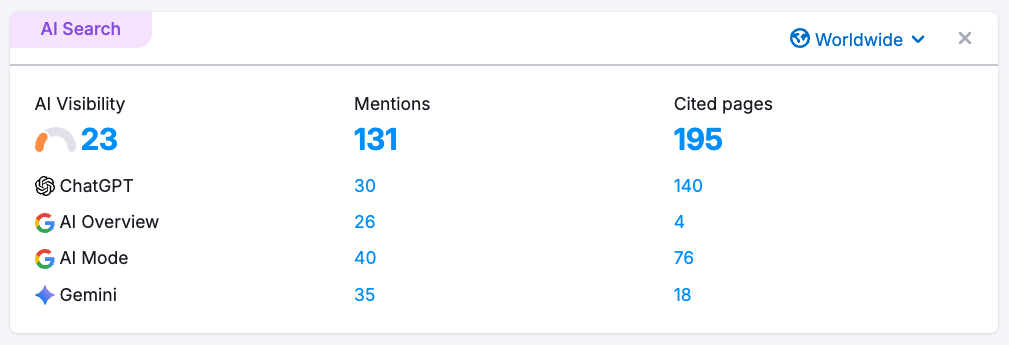
Figure: Semrush shows that this website here has started to build up authority but still has a long way to go!
Focus on
- Mentions in niche forums
- Participation on Reddit and Quora
- Citations from respected industry communities
- Helpful, non-promotional contributions that naturally reference your brand
Summary
AEO/GEO is no longer optional. By optimizing for AI systems through structured data, readable content, community presence, and emerging technical standards, you future-proof your brand’s visibility in the next generation of search.