Do you avoid using 7/10 when giving feedback?
Loading last updated info...
Giving something a "7/10" often says very little. It avoids answering the real question of whether it's actually good enough, replacing a clear opinion with a vague score.
Why 7/10 is a cop-out
When someone asks "how was it?" or "is this good?", a 7/10 score sounds polite, but is really just sitting on the fence:
- Doesn't say what's wrong
- Doesn't say what's right
- Doesn't say what to do next
It protects the reviewer from an uncomfortable conversation, but it leaves the person asking with nothing they can act on.
Note: This isn't a rule against using numbers. Scores like 8/10 or 9/10 can be a great way to recognize good work, especially when paired with specific feedback.
The problem is giving a noncommittal middle score, such as 7/10, without explaining what it means. A clear score backed by actionable feedback is just as useful as a simple pass or fail.
What to do instead
If it's not ready to ship, say so and explain why. If it is ready, say that clearly and specifically.
- Use " ✅ Pass / ❌ Fail " when the decision is whether something is ready to go live
- When you give a score, make it decisive - An 8 or 9 says something. So does a 2 or 3. A 7 usually doesn't
- Always justify the score - Explain exactly what's standing between the score given and a 10. E.g.: "Not ready to ship because {{ REASON }}"
- Be specific - List the exact things that need to change
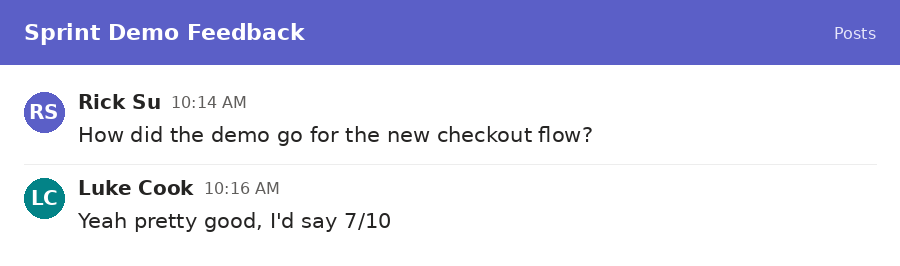
❌ Figure: Bad example - A vague score gives the team nothing to act on
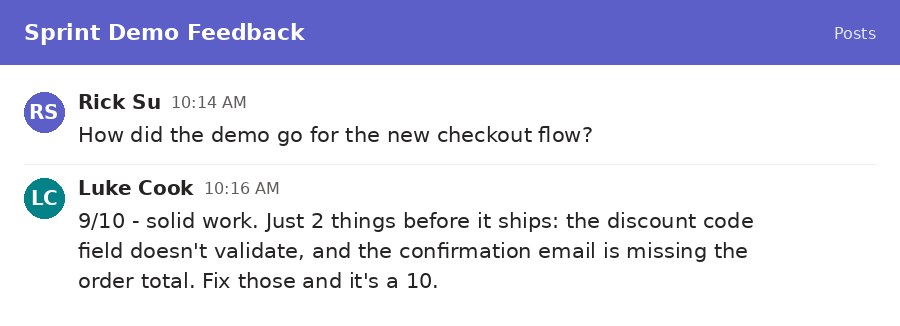
✅ Figure: Good example - A decisive score plus specific feedback the team can act on
Tip: When requesting feedback, ask reviewers not to use 7/10 and link them to this rule.